Joint usage of OASIS3-MCT and XIOS in climate models#
Arnaud Caubel (LSCE/IPSL), February 2022
Both OASIS3-MCT (CERFACS) and XIOS (LSCE/IPSL) are widely used in the climate modeling community, respectively to handle coupling and Input/Output in numerical models. Since the exchange protocol of these tools are based on messages within MPI communicators which can be shared by the tools, some good practices are useful to use conjointly OASIS3-MCT and XIOS within one same model (Fig 1.)
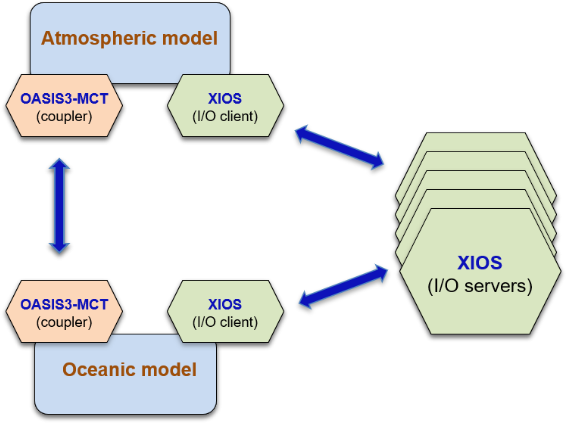
Figure 1 : Coupled model using OASIS3-MCT as coupler and XIOS as I/O server
1. Interfacing with OASIS3-MCT and XIOS within a climate model#
a. Initialisation phase#
From the OASIS3-MCT and XIOS point of view, the objective of this step is both to initialize the MPI library (calling MPI_Init), if not already initialized by the model, and to create a local communicator to be used by the model for its internal parallelization (Fig 2). Both OASIS3-MCT and XIOS fulfill these functions thanks to oasis_init_comp and oasis_get_localcomm API routines for OASIS3-MCT and xios_initialize (that calls the OASIS3-MCT API routines) for XIOS. In order to avoid duplicating tasks, the call to these API routines must be ordered in the component as proposed in the two following examples:
CALL oasis_init_comp( comp_id, "ocean", status)
CALL oasis_get_localcomm (ilocal_comm, status )                (1)
CALL xios_initialize( "ocean", local_comm=ilocal_comm , return_comm=ilocal_comm)
CALL xios_initialize( "ocean", return_comm=ilocal_comm) (2)
In case (1), the call to OASIS3-MCT initialization API routines allows to initialize the MPI library (calling MPI_Init if not already initialized by the model) and to get the value ilocal_comm of a local communicator handle. Then, the call to xios_initialize returns return_comm the handle of a communicator that is in fact a duplication of the local_comm communicator. Note that XIOS 3 requires to use this specification.
In case (2), XIOS handles the initialization of OASIS3-MCT (and MPI if needed) by calling internally oasis_init_comp and oasis_get_localcomm API routines and returning the split local communicator handle as return_comm argument.
In both cases (1) and (2), the call to xios_initialize allows XIOS to pick up an inter-communicator between the model component (XIOS client) and XIOS servers by calling the OASIS3-MCT oasis_get_intercomm API routine: this inter-communicator is needed by XIOS to create a communicator and achieve communications between model component processes and XIOS servers (Fig 2).
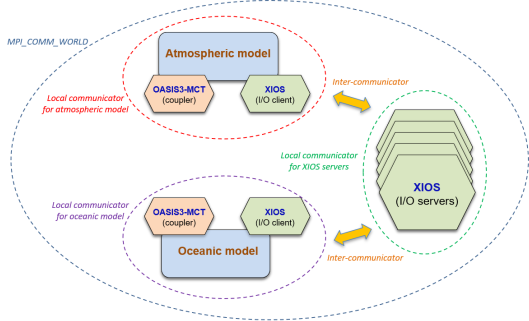
Figure 2 : Handling of MPI communicators in a coupled model using OASIS3-MCT as coupler and XIOS as I/O server
b. Definition phase#
In the model component, the OASIS3-MCT definition phase is finalised by calling the oasis_enddef API routine. This routine includes global collective MPI communications (using the MPI_COMM_WORLD communicator). The XIOS xios_context_initialize subroutine initializes one or several XIOS context(s) and also includes collective MPI communications. Hence, deadlocks may occur if the developer does not pay any attention to the calling order of the two subroutines. The calling rule depends on the version of XIOS, as follows:
- (i) XIOS version branch 2.5 or trunk (before revision 1587)
In order to avoid deadlocks, it is mandatory to call first oasis_enddef and then xios_context_initialize in all the components involved in the coupling, to be coherent with the calling order of XIOS servers. A calling sequence in your models could be as follows:
CALL oasis_enddef
…
CALL xios_context_initialize (xios_context, local_comm)
- (ii) XIOS version trunk (revision 1587 or later, including XIOS 3 up to XIOS-3.0.2.0)
A XIOS functionality was developed to explicitly inform XIOS servers they have to call oasis_enddef function. This function, xios_oasis_enddef, allows to solve deadlocks encountered in case of bad call order of oasis_enddef and xios_context_initialize.
The call to xios_oasis_enddef needs to be implemented before the call to oasis_enddef on model side as follows:
…
CALL xios_oasis_enddef
CALL oasis_enddef
…
CALL xios_context_initialize (xios_context, local_comm)
…
or
CALL xios_context_initialize (xios_context, local_comm)
…
CALL xios_oasis_enddef
CALL oasis_enddef
…
The XIOS parameter call_oasis_enddef (default value is true) must be set in iodef.xml file:
true:xios_oasis_enddeffunction must be called in every component involved in the coupling.false: the functionality is deactivated and the behavior of XIOS version branch 2.5 or trunk < revision 1587 is retrieved, i.e.xios_oasis_enddeffunction does not need to be called in the models but deadlocks may happen in case of bad call order ofoasis_enddefandxios_context_initialize.
- (iii) From XIOS-3.0.2.0 :
The XIOS servers benefit from the coupled option of oasis_init_comp, this allows the servers to be not considered during the collective MPI communications of OASIS (in oasis_enddef and oasis_terminate).
The call to xios_oasis_enddef and the XIOS parameter call_oasis_enddef have become useless.
c. Finalisation phase#
The finalization sequence must be similar to the initialization one. If OASIS3-MCT has initialized MPI (oasis_init_comp), the MPI finalization will be done by OASIS3-MCT in the oasis_terminate API routine, either called directly by the model (case (3)) or within xios_finalize (case (4)).
CALL xios_finalize                                                            (3)
CALL oasis_terminate
or
CALL xios_finalize (4)```
2. Compilation parameters#
XIOS#
Compilation with --use_oasis is mandatory to use OASIS3-MCT API routines in XIOS (XIOS C-fortran interface of OASIS3-MCT API routines is defined only if --use_oasis is specified).
./make_xios --use_oasis…
OASIS3-MCT#
Nothing to do at compilation step.
3. Runtime parameters#
XIOS : iodef.xml#
Some OASIS3-MCT parameters have to be enabled in iodef.xml:
using_oasis: true if OASIS3-MCT is used as coupler. Default value:false.call_oasis_enddef: see part 1.b; default value istrue.-
oasis_code_id(XIOS 2)/clients_code_id(XIOS 3): identifiers of model component using both OASIS3-MCT and XIOS (these identifiers must be the same as the one defined as argument ofoasis_init_compandxios_context_initializeAPI routine). Only used if XIOS server mode is enabled.- XIOS 2 :
<variable id="using_oasis" type="bool">true</variable> <variable id="oasis_codes_id" type="string" >atmos,ocean</variable> - XIOS 3 :
  <variable id="using_oasis"     type="bool">true</variable>
  <variable id="clients_code_id"  type="string" >atmos,ocean</variable>
- XIOS 2 :
OASIS3-MCT : namcouple#
With OASIS3-MCT version prior to 3.0, model identifiers defined in XIOS iodef.xml must be the same as the one defined in the OASIS3-MCT namcouple configuration file and the one defined as argument of oasis_init_comp API routine. xios.x is the identifier to be used for XIOS component in namcouple file, as follows:
$NBMODEL
3 atmos ocean xios.x
We note however that since version 3.0 of OASIS3-MCT, this namcouple parameter is not used anymore.